
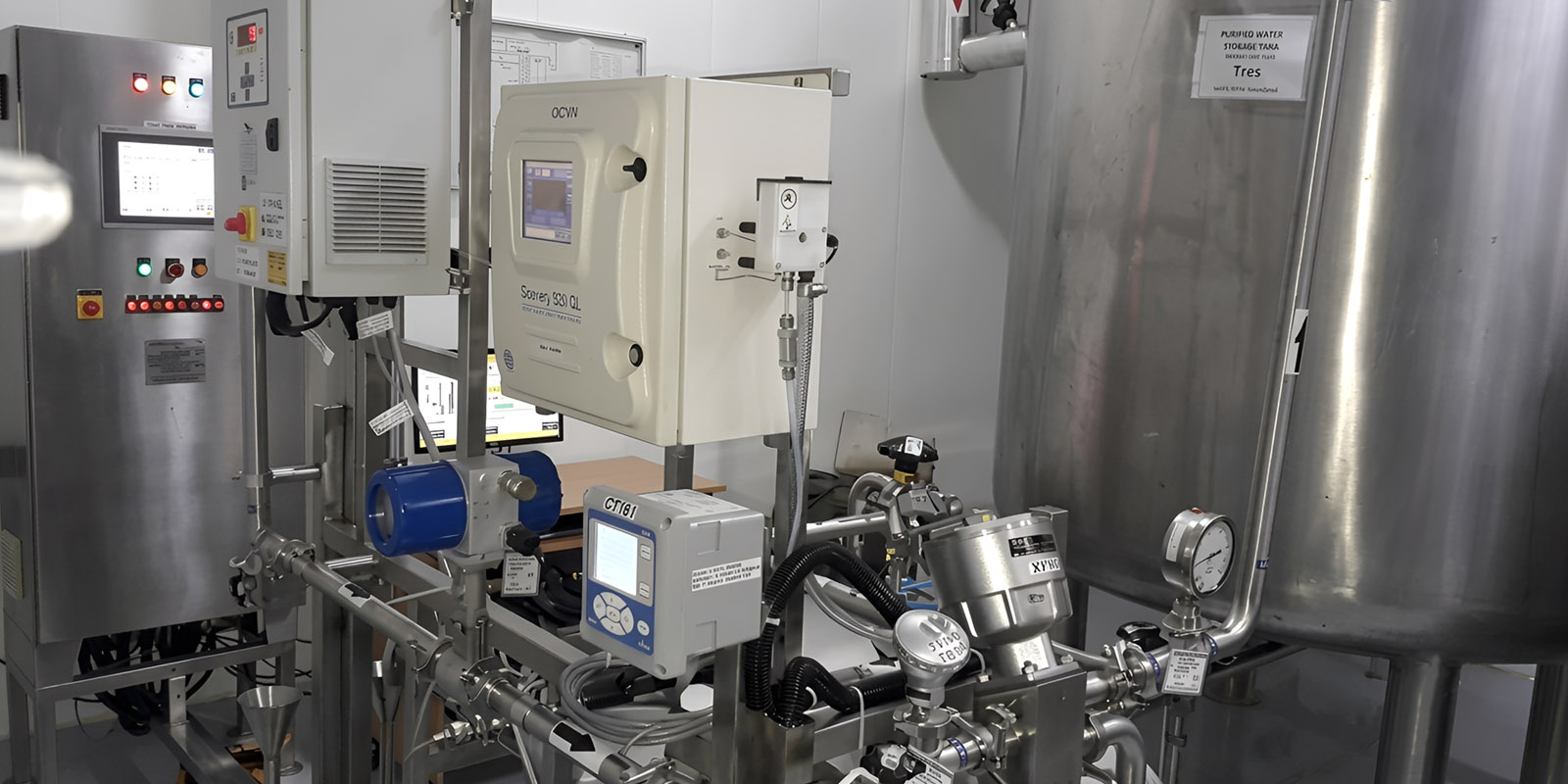
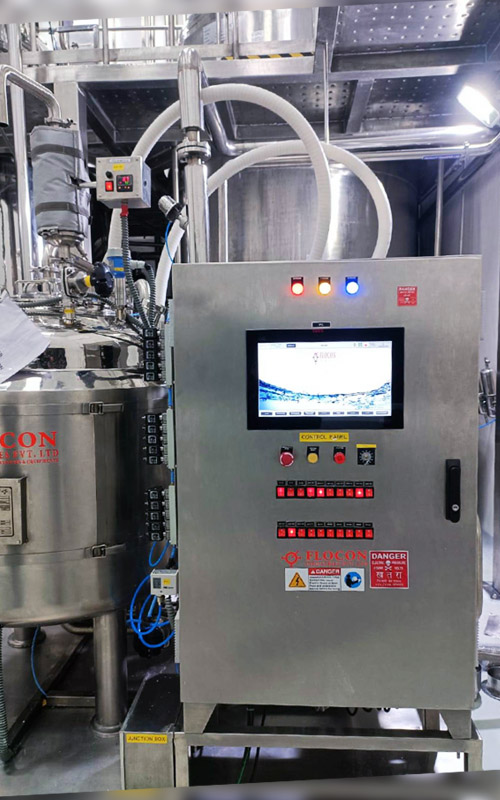
Flocon Industries delivers every high-purity water system with a fully integrated, automatic process automation platform that is engineered to eliminate operator dependence and ensure audit-ready performance across every stage of water purification. At the core of each system is a robust PLC-based control panel that orchestrates the complete process sequence based on programmed process logic. This encompasses pre-treatment, RO production, storage, distribution, and sanitisation. A touch-screen HMI provides operators with a control interface for real-time process oversight, manual control, and set-point adjustment. An IPC-based SCADA platform delivers plant-wide operational status and centralised data logging to analyse trends and provide regulatory-grade reporting.
Every system is engineered to meet 21 CFR Part 11 standards, incorporating time-stamped electronic records, role-based user access control, electronic signatures, and a tamper-evident audit trail. This ensures you receive complete data integrity and regulatory traceability for FDA, EU GMP, and WHO inspections. Features such as automated equipment interlocks, conductivity-triggered divert-to-drain logic, UV lamp failure protection, and low-flow shutdown sequences prevent out-of-specification water from reaching your point of use, ensuring consistent process quality. Additionally, real-time monitoring of conductivity, TOC, temperature, flow rate, pressure, and UV intensity supports continuous alarm management with configurable alert and action thresholds. Our systems are engineered for critical applications in accordance with global standards of excellence for control of water systems to decrease human dependence and increase process productivity.

21 CFR Part 11 compliance control system available.

Reputed quality of PLC, HMI and Drives from manufacturers like Rockwell Automation, Siemens, Schneider, and Delta.

Control panel Logics are tested at factory before dispatch.

SS304 Durable stainless steel construction for control panel housing.

Critical parameters printing facility available.

Premium quality of auto valves and control instruments for trouble free and long operating life.

Data logging and 21CFR Part 11 compliance with IPC or desktop PC options available.
| Process Automation | |
|---|---|
| System Parameters | Typical Requirement |
| Digital Inputs | Pump status, valve feedback, level switches, alarms |
| Digital Outputs | Pump start/stop, solenoid valves, actuators |
| Analog Inputs | Conductivity, temperature, pressure, flow, level |
| Analog Outputs | Control valves, VFD speed reference |
| Control Logic | Auto / Manual / Semi-auto |
| Interlocks | Pump, valve, pressure, level, temperature and process interlocks |
| HMI Based User Interface | |
|---|---|
| System Parameters | Typical Requirement |
| Equipment Status | Pump/valve/device status |
| Process Values | Flow, pressure, temperature, conductivity, level |
| Setpoints | Authorized adjustment of process setpoints |
| Equipment Control | Start/stop/open/close functions as permitted |
| User Levels | Operator / Supervisor / Engineer |
| Process Mimic | Graphical representation of piping/equipment |
| SCADA | |
|---|---|
| System Parameters | Typical Requirement |
| Process Visualization | Graphical plant/process mimic |
| Real-Time Monitoring | Continuous parameter display |
| Event Logging | System/operator events |
| Reports | Batch/process/parameter/alarm reports |
| Audit Trail | Secure, time-stamped audit trail |
| Operating System | Validated OS configuration |
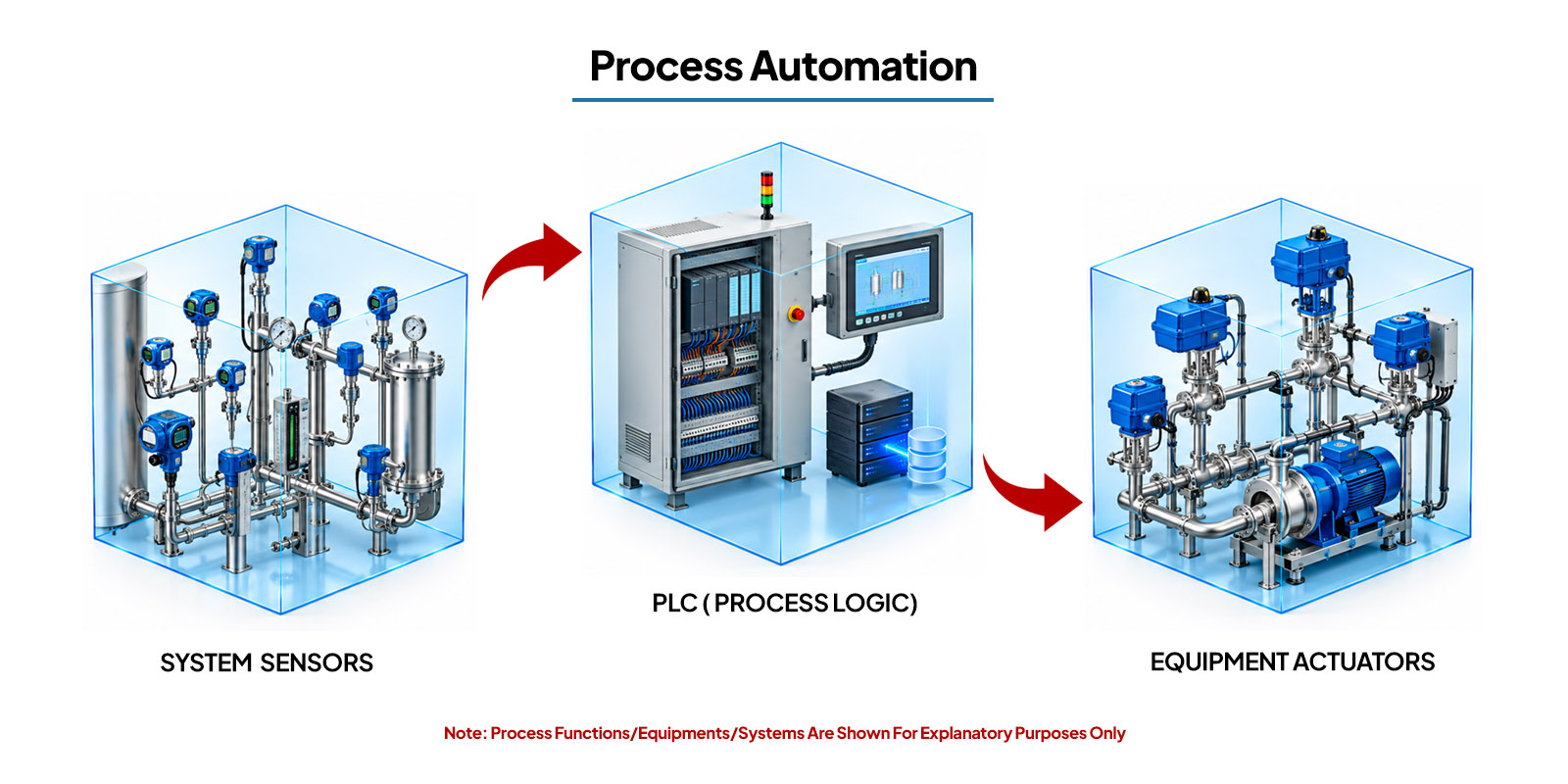
Continuously measure critical process parameters such as TOC, pressure, flow rate, temperature, UV intensity and level.
Processes sensor inputs, compares them with actionable thresholds to execute programmed control process logic, operation sequences, failure protection alarms, interlocks, etc.
Receive PLC commands and operate pumps, valves and other equipment to maintain the required process conditions.
Years of advisory, purification expertise and client trust for storage and distribution systems
Positive passing rate of US FDA, WHO, and EU GMP ( Annex 1) compiance audits
Complete DQ/IQ/OQ validation package along with supporting documentation followed by protocol execution support.
Designed to meet current USP/BP/EU pharmacopoeia standards and WHO / cGMP requirements.





Find answers to common questions about our industrial and manufacturing services, processes, and support. If you need more details, our team is always ready to help.
Our experts are here to guide you through every step of your industrial transformation journey.
Process automation in pharmaceutical water system and Ultrapure water systems uses PLC/SCADA, sensors, transmitters, valves, and control logic to automatically monitor and control water treatment, storage, distribution, and sanitization. It maintains critical parameters such as flow, pressure, temperature, conductivity/resistivity, TOC, and tank levels within defined limits. Automation supports GMP by improving process consistency, reducing operator error, providing alarms and interlocks, and creating reliable electronic records for traceability and trending. It also supports deviation investigation and preventive maintenance. The automation system must itself be qualified and validated, with controlled user access, audit trails, data integrity, backups, calibration, cybersecurity, and documented change control.
A SCADA (Supervisory Control and Data Acquisition) system connects to PLCs, sensors, transmitters, and instruments throughout the pharmaceutical water system. It continuously collects parameters such as flow, pressure, temperature, conductivity, TOC, tank level, and system status. SCADA displays real-time process conditions, generates alarms when parameters exceed predefined limits, and records historical data for trending and review. It can also provide electronic batch or cycle records for processes such as sanitization. For GMP compliance, SCADA should use validated software, controlled user access, audit trails, secure data storage, backups, time synchronization, and appropriate electronic-record controls, ensuring data remains accurate, complete, attributable, and retrievable.
21 CFR Part 11 is an FDA requirement for ensuring that electronic records and electronic signatures used in regulated pharmaceutical processes are trustworthy, reliable, and equivalent to paper records.
For a pharmaceutical water-system SCADA, this means:
In practice, Part 11 applies when SCADA-generated electronic records are relied upon for GMP-regulated activities or quality decisions.
EU GMP Annex 11 governs computerized systems used in GMP operations, including PLC/SCADA systems controlling pharmaceutical water generation, storage, distribution, and sanitization. It emphasizes risk-based validation, data integrity, access control, audit trails, electronic records, backup, change control, incident management, and periodic review.
21 CFR Part 11 is the corresponding U.S. FDA framework for electronic records and electronic signatures.
The key difference is that Annex 11 is broader and more lifecycle/risk-focused, covering the computerized system and its GMP processes, while Part 11 focuses more specifically on the reliability, integrity, and regulatory acceptability of electronic records and electronic signatures. Both require validated, secure, traceable systems.
GAMP 5 (Good Automated Manufacturing Practice 5) is a risk-based framework developed by ISPE for validating computerized systems used in regulated pharmaceutical manufacturing. For a pharmaceutical water system, GAMP 5 guides validation of PLC, SCADA, HMI, historian, and related software.
The process typically includes defining the URS, performing a GMP and risk assessment, assessing suppliers, developing functional/design specifications, and conducting documented testing such as IQ/OQ/PQ or equivalent verification. Critical functions—alarms, interlocks, control sequences, data recording, access controls, audit trails, and electronic records—are tested. Lifecycle controls include change management, deviation handling, backup, cybersecurity, periodic review, and revalidation to maintain the validated state.
A pharmaceutical water-system SCADA network should use a defense-in-depth, risk-based cybersecurity approach:
Share your equipment queries, raw water parameters or loop requirements. Our engineering team will review your requirements and get in touch within 48 hours to clarify your queries and provide you with our best purity solutions.