
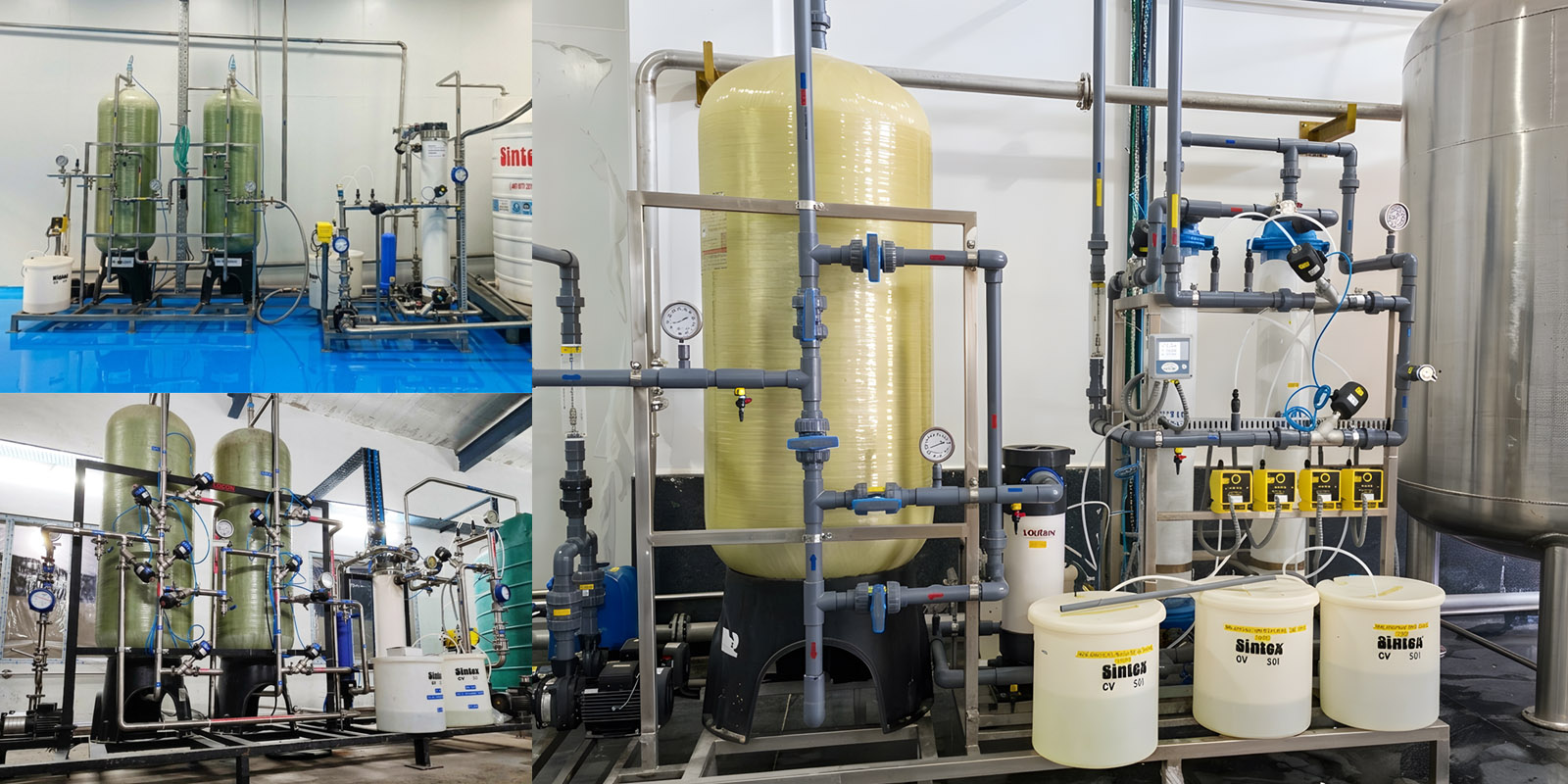
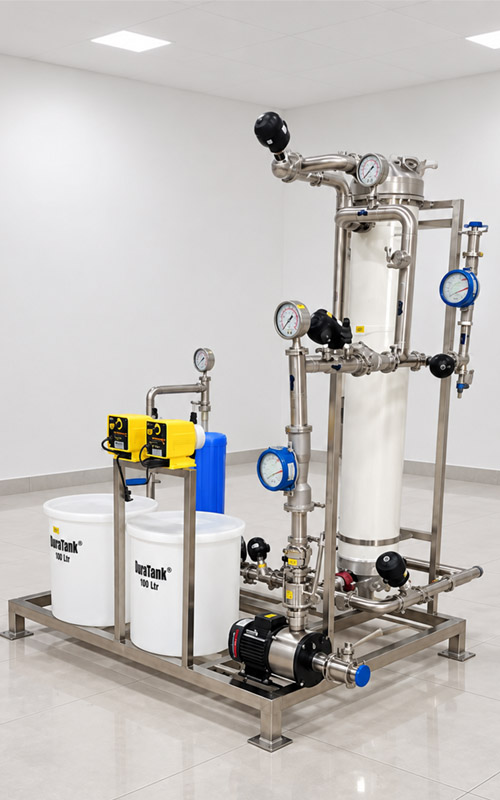
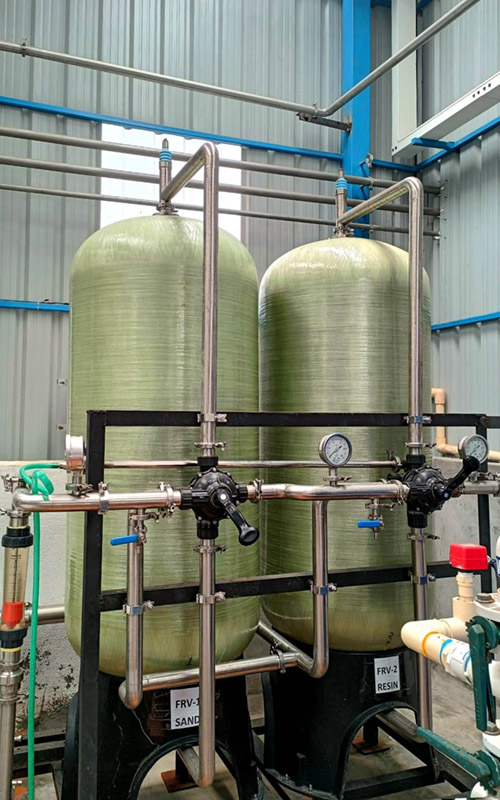
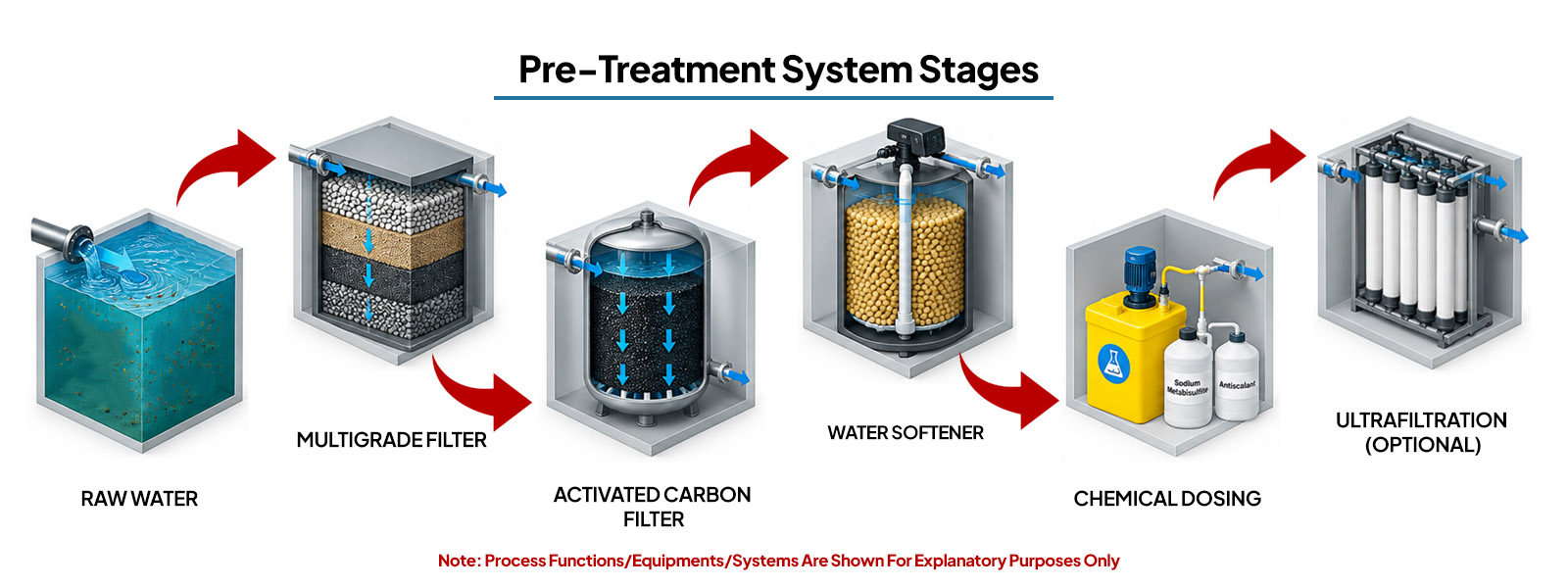
Flocon Industries’ water Pre-Treatment System solution is a critical component of the pharmaceutical water purification process, designed to condition raw water before it enters advanced purification stages such as Reverse Osmosis (RO), Ultrafiltration (UF), Electro-Deionization (EDI), Distillation, or Water for Injection (WFI) systems. Our pre-treatment systems are optimised to target and primarily remove suspended solids, turbidity, hardness, chlorine, organic contaminants, colloidal particles, dissolved gases, and microbial load that can adversely affect downstream purification equipment efficiency and final output high-purity water quality. Our pre-treatment systems are engineered using advanced filtration technologies, pharmaceutical-grade materials, and intelligent automation to ensure consistent water quality, operational reliability, and compliance with global pharmacopeia regulations and standards.

GMP-Compliant Design

SS304 / SS316L Construction

Fully Automatic Operation
PLC & SCADA Integration

Compact Skid-Mounted Design

Low Maintenance Requirements

Energy Efficient Operation

Future Expansion Capability
| Pre-treatment Systems | |
|---|---|
| Parameters | Range / Requirements |
| Turbidity | < 1 NTU |
| Free Chlorine | < 0.1 ppm |
| Hardness | < 5 ppm |
| Iron | < 0.1 ppm |
| SDI | < 3 |
| pH | 6.5 – 8.5 |
| Conductivity | As per feed water quality |
| Suspended Solids | Minimal |
| Microbial Load | Controlled |
Supplies purified process water (Reverse Osmosis, Purified Water, or Water for Injection) as the base for cleaning/rinsing of the target system/equipment.
Stores measured quantities of wash water and chemical formulations at regulated temperatures for the cleaning process.
Provides a consistent flow rate and hydraulic pressure to cleanse and scrub internal equipment/system surfaces effectively.
Supplies cleaning formulations through sanitary piping and valves to sanitise specific equipment/systems.
It is the target unit where the cleaning formulation is sprayed with pressure to wash and sanitise the interior walls and internal contact surfaces.
Executes automated cleaning sequence phases (pre-rinse, chemical wash, intermediate flush, and final high-purity rinse) to wash away any contaminant residue or cleaning formulation.
Complete DQ/IQ/OQ validation package along with supporting documentation followed by protocol execution support.
Designed to meet current USP/BP/EU pharmacopoeia standards and WHO / cGMP requirements.



Find answers to common questions about our industrial and manufacturing services, processes, and support. If you need more details, our team is always ready to help.
Our experts are here to guide you through every step of your industrial transformation journey.
A pretreatment system is the initial treatment stage for pharmaceutical water, preparing incoming potable/feed water for downstream purification such as RO, EDI, or distillation. Typical components include multimedia filtration, activated carbon, water softening, cartridge filtration, and sometimes ultrafiltration. Pretreatment removes suspended solids, turbidity, chlorine, hardness, organic matter, and microorganisms. It is required to protect downstream membranes, resins, heat exchangers, and distillation equipment from fouling, scaling, and damage. Effective pretreatment improves purification efficiency, extends equipment life, reduces maintenance, and supports consistent production of Purified Water and WFI. Pretreatment parameters should be routinely monitored and controlled to maintain reliable system performance.
An ultrafiltration (UF) system purifies feed water using a pressure-driven membrane with very small pores, typically around 0.01–0.1 microns. Ultrafiltration membranes also work on a molecular weight cut off rating. The membrane acts primarily as a size-exclusion barrier, allowing water and small dissolved substances to pass while retaining larger contaminants. Bacteria, colloids, suspended solids, and many microorganisms are effectively rejected because they are larger than the membrane pores. UF can also provide substantial removal of many viruses, although performance depends on membrane pore size, virus characteristics, and operating conditions. UF does not reliably remove dissolved salts or low-molecular-weight organics, so RO, ion exchange, or other processes are often used downstream.
Water softening is not always essential before reverse osmosis (RO) in a pharmaceutical water system, but it is commonly used when feed-water hardness creates a significant scaling risk. Softening removes calcium and magnesium ions, protecting RO membranes from scale formation and maintaining flux and rejection performance. The need depends on feed-water quality, RO recovery, temperature, membrane type, and overall system design. Where hardness is low, softening may be unnecessary. Alternatives such as antiscalant dosing, lower recovery, or other pretreatment may control scaling. The selected approach should be supported by a documented risk assessment, qualification, monitoring, and demonstrated RO performance.
SDI (Silt Density Index) measures the fouling potential of feed water caused by suspended and colloidal particles. It is particularly useful for assessing water entering RO membranes. A lower SDI indicates cleaner water and lower risk of membrane fouling.For pharmaceutical water pretreatment, a common design target is SDI ≤3, while SDI ≤5 is generally considered an upper limit for many RO applications. Achieving ≤3 provides a better operating margin and helps protect RO membranes. The target should ultimately be established based on the RO manufacturer’s requirements, feed-water characteristics, pretreatment design, and validated system performance. SDI should be routinely monitored and trended.
A pharmaceutical water pretreatment system is qualified using a risk-based DQ/IQ/OQ/PQ approach:
The objective is to demonstrate that pretreatment reliably protects downstream RO/EDI/distillation and consistently produces suitable feed water.
Size each pretreatment unit from the maximum required flow, feed-water quality, operating hours, and required water quality—not average consumption alone.
Share your equipment queries, raw water parameters or loop requirements. Our engineering team will review your requirements and get in touch within 48 hours to clarify your queries and provide you with our best purity solutions.