

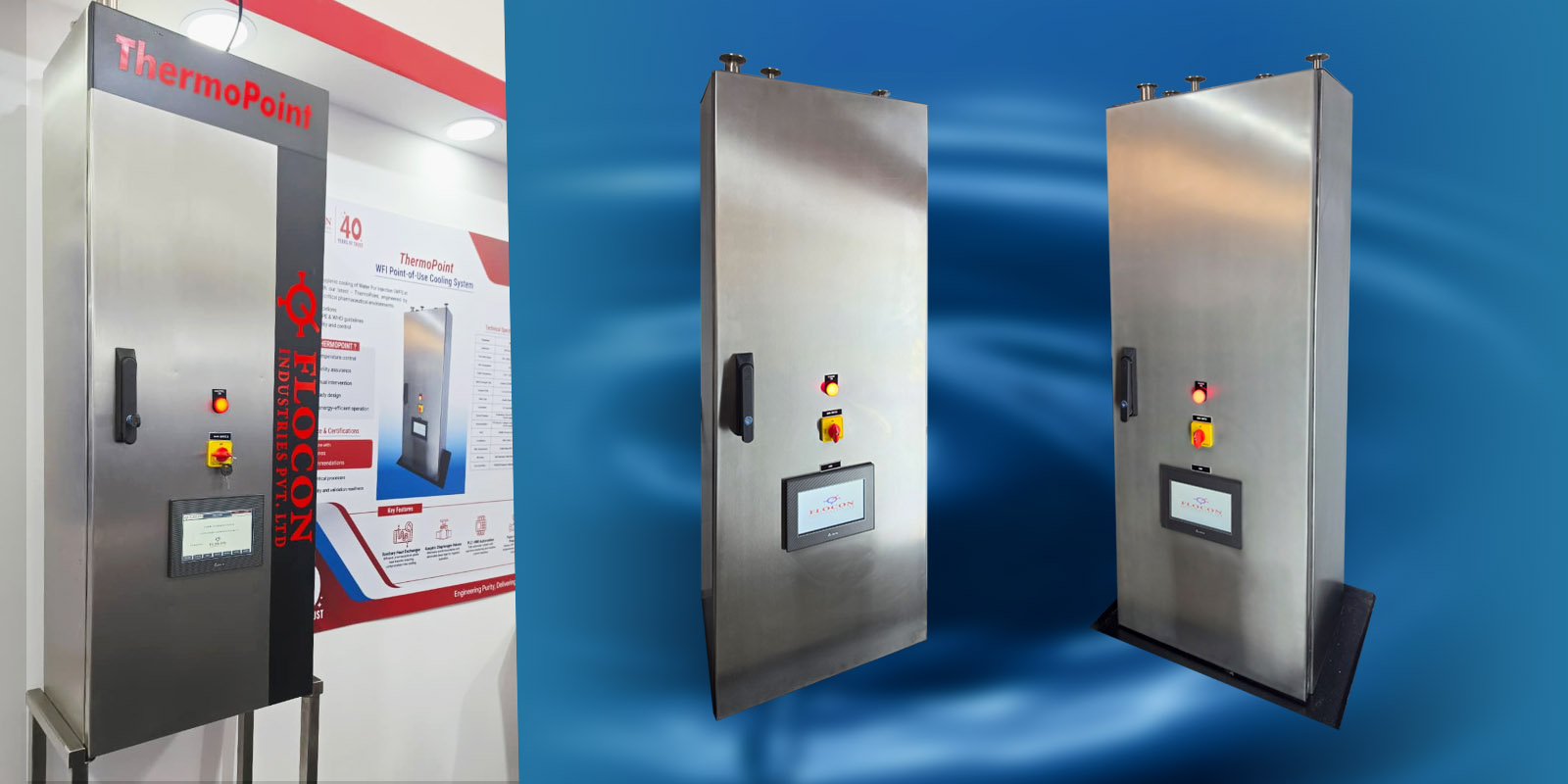
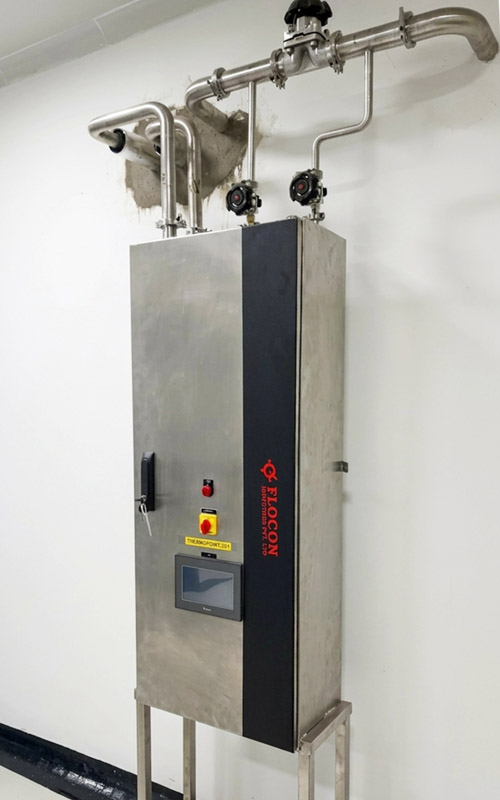
ThermoPoint™ POU Cooler by Flocon Industries is a compact, hygienic, and fully drainable Point-of-Use (POU) Water for Injection (WFI) cooling solution designed for pharmaceutical and biotech applications requiring ambient or thermally controlled supply of purified water. Engineered with SS316L electropolished construction and a sanitary heat exchanger, ThermoPoint ensures rapid cooling while maintaining the highest standards of sterility, cGMP, ASME BPE, and ISPE compliance. Its integrated PLC/SCADA compatibility, SIP capability, and optimised sanitary design help minimise microbial risk, support validation requirements, and ensure reliable delivery of cooled WFI directly at the point of use. The ThermoPoint™ POU Cooler is designed as per ISPE & WHO guidelines and optimised for sterility and control, making it ideal for Good Manufacturing Practice (GMP) certification process applications.

Built for GMP applications

Utility Requirement Chilled Water (8°C – 12°C)

Designed as per ISPE & WHO guidelines

Heat Exchanger Type - Sanitary (SS316L) Shell and Tube

Optimized for sterility and control

Automation - PLC with HMI Interface

Flow Rate Range 100 – 6000 LPH (customizable)

Control Features Temperature, Flow & Pressure Monitoring (As Per requirement)

Inlet Temperature Up to 85°C

Mounting - Skid-Mounted / Wall-Mounted Options

Outlet Temperature 20°C – 35°C (adjustable)

Documentation DQ/IQ/OQ Support, Material Traceability
| Thermopoint - Point of Use Cooler | |
|---|---|
| Flow Rate Range | 100 – 6000 LPH |
| Inlet Temperature | Up to 85°C |
| Outlet Temperature | 20°C – 35°C (adjustable) |
| Heat Exchanger Type | Sanitary (SS316L) Shell and Tube |
| Surface Finish | ≤ 0.4 µm Ra (electropolished) |
| Valve Type | Aseptic Diaphragm Valves |
| Automation | PLC with HMI Interface |
| Control Features | Temperature, Flow & Pressure Monitoring (As Per requirement) |
| Instrumentation | RTD Sensors, Pressure Transmitters, Flow Meters (As Per requirement) |
| MOC | SS316L (Product Contact Parts) |
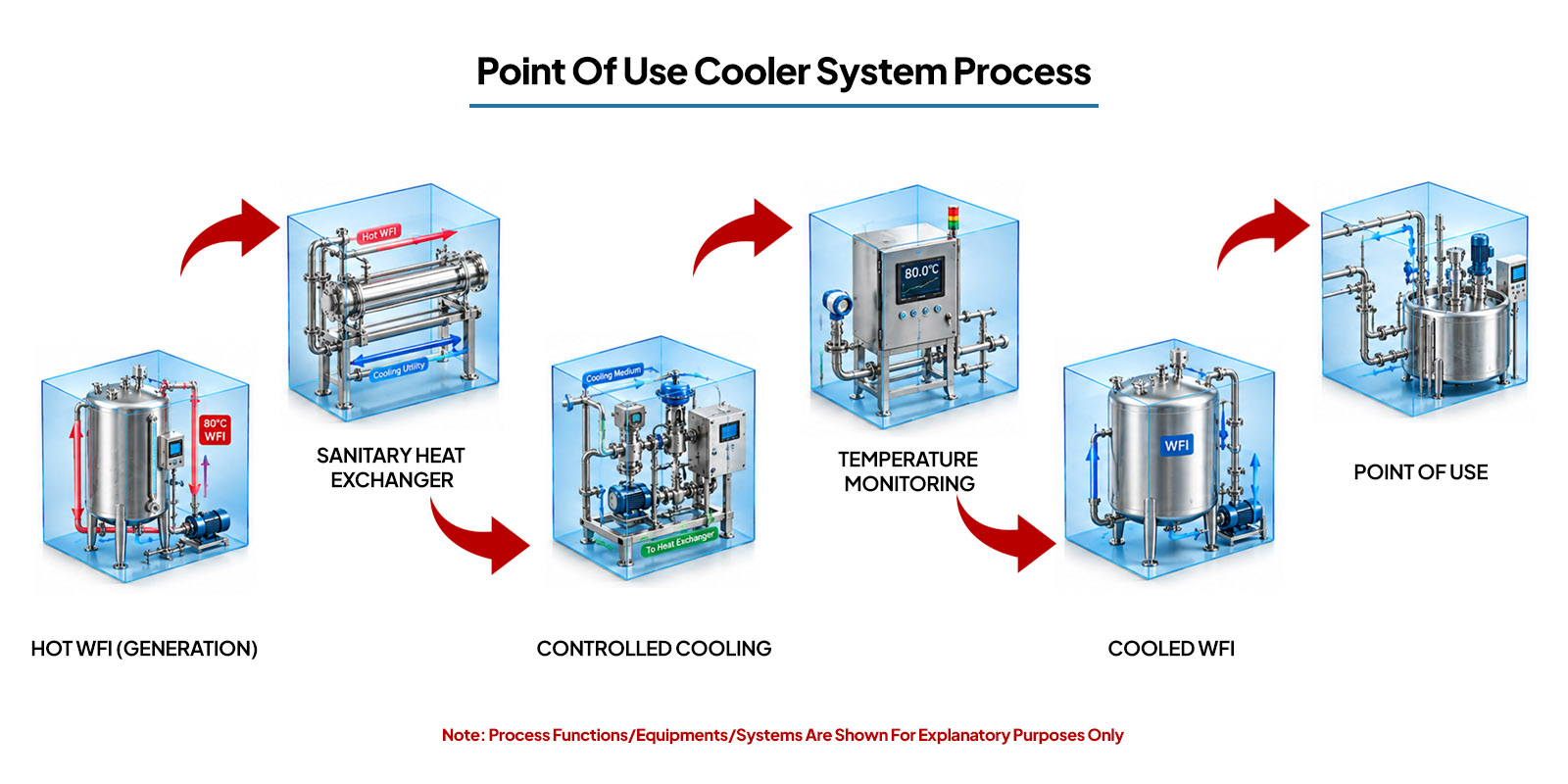
Continuously circulates thermally treated and sanitised Water for Injection (WFI) at high temperatures (>80°C) to prevent microbial growth.
Exchanges heat between the cooling medium and the high-purity water using a double tube-sheet, contamination-free design to reduce the temperature of the hot WFI.
Regulates the circulation of the cooling medium to lower the WFI temperature to the exact amount required for the processing application.
Tracks sensors continuously to log discharge water data in real time to ensure compliance with GMP critical process parameters.
Denotes the thermally regulated, parenteral-grade water that is ready to be extracted for applications, free from any contaminants.
The application valve that supplies the cooled WFI into manufacturing operations, formulations, and chemical processes under hygienically controlled conditions.

Complete DQ/IQ/OQ validation package along with supporting documentation followed by protocol execution support.

Designed to meet current USP/BP/EU pharmacopoeia standards and WHO / cGMP requirements.






Find answers to common questions about our industrial and manufacturing services, processes, and support. If you need more details, our team is always ready to help.
Our experts are here to guide you through every step of your industrial transformation journey.
A Point of Use (POU) WFI cooler is a device installed near the point where Water for Injection (WFI) is used in a pharmaceutical manufacturing system. It cools hot WFI, typically maintained and distributed at elevated temperatures for microbial control, to a suitable temperature for immediate manufacturing or process use. The cooler is needed when the required process temperature is lower than the WFI distribution temperature. It helps prevent product or equipment damage, improves operator safety, and provides water at the desired process temperature. The cooling system must be hygienically designed to prevent contamination and maintain WFI quality at the point of use.
A Point of Use (POU) WFI cooler is designed to comply with zero dead-leg and GMP piping requirements by ensuring that all product-contact surfaces are continuously drainable, cleanable, and exposed to the flowing WFI.
The key principle is that the cooler should not create a stagnant pocket or bypass area that cannot be effectively sanitized and drained.
A POU WFI cooler may use different cooling media depending on the required outlet temperature, plant utilities, and GMP requirements. Chilled water is commonly preferred because it provides reliable and controlled cooling. Glycol-water mixtures may be used when lower temperatures or freeze protection are required, particularly in centralized chilled-water systems. Ambient or potable water can be used when the incoming water temperature is sufficiently low and only moderate cooling is required. In all cases, the cooling medium remains completely separated from the WFI by a hygienic heat exchanger. The selected medium should provide adequate heat-transfer performance while preventing contamination and maintaining consistent WFI quality.
In a hot WFI loop, the distribution temperature is generally maintained at a validated elevated temperature to control microbial growth. A POU cooler should therefore provide cooling only when WFI is required at a lower process temperature. The outlet temperature setpoint is determined by the process requirement and validated, commonly around 20–30°C, rather than by a universal GMP value. Temperature control should use a calibrated temperature sensor, automatic control valve, and suitable PLC/SCADA monitoring. The system should prevent excessive cooling, temperature overshoot, and stagnant conditions. Alarm limits, sensor calibration, response time, and temperature mapping should be established through GMP qualification and validation.
A POU cooler is cleaned and sanitised as part of the validated pharmaceutical water system. Cleaning typically uses CIP with hot WFI/PW or an approved chemical sanitant, followed by validated rinsing and complete draining. For a hot WFI loop, the cooler should be compatible with thermal sanitisation/SIP, where applicable. Qualification normally includes IQ, OQ, and PQ. IQ verifies materials, welds, installation, slope, and documentation. OQ challenges temperature control, flow, alarms, and sanitisation parameters. PQ confirms consistent performance and microbiological/chemical water quality at the POU under routine operating conditions. Sanitisation effectiveness is demonstrated through documented cycles, sampling, acceptance criteria, and trend analysis.
For a sanitary POU WFI/PW cooler, maintenance intervals should be established through the manufacturer’s recommendations, risk assessment, and site preventive-maintenance program. Typical requirements include:
Share your equipment queries, raw water parameters or loop requirements. Our engineering team will review your requirements and get in touch within 48 hours to clarify your queries and provide you with our best purity solutions.