
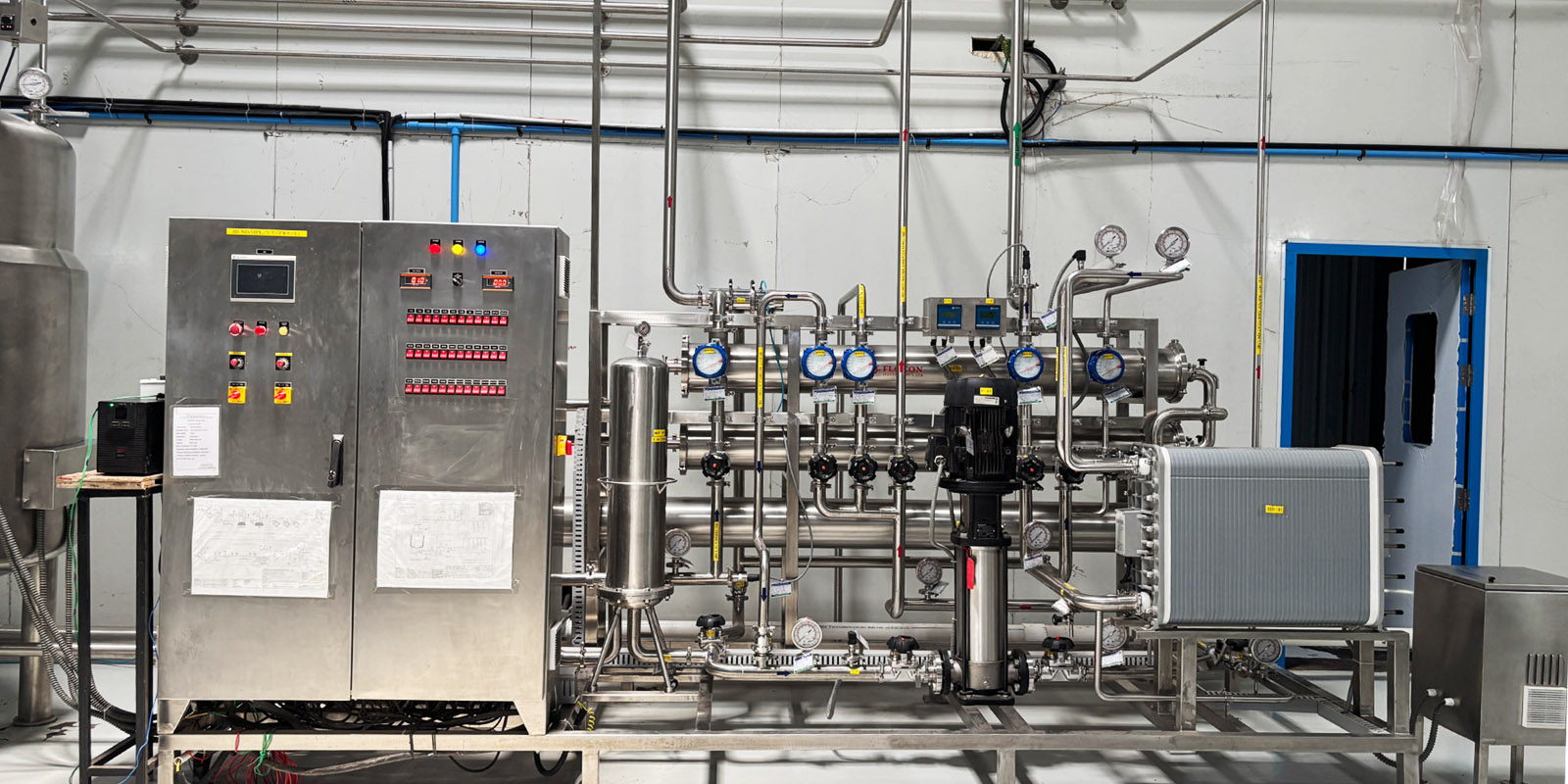
Purified Water(PW) Generation System by Flocon Industries is an advanced engineered solution, designed to consistently produce Purified Water (PW) within defined pharmacopoeial limits and stringent quality standards, while maintaining operational effciency. Our solution begins with a detailed analysis of feed water characteristics, including parameters such as conductivity, Total Dissolved Solids (TDS), hardness, silica, microbial load, Total Organic Carbon (TOC), pathogens and seasonal variations. Based on these input parameters, we engineer and integrate an optimised treatment process with effective monitoring and output control to ensure reliable and reproducible water quality.
Our Purified Water generation process typically incorporates a combination of advanced technologies, including Pretreatment Systems, Softening, Reverse Osmosis (RO), Electro Deionisation (EDI), Ultrafiltration (UF), Membrane Degassing etc. Each stage is carefully designed to control critical quality attributes and consistently meet the required specifications. To maintain standardised water quality throughout the lifecycle, our Purified Water system is designed with hygienic construction, optimised flow velocities, dead-leg minimisation, automated sanitisation, and validated systems. This approach ensures that the generated water consistently remains within specified limits from generation to point of use.
Flocon systems consistently generate and maintain key process parameters such as:
Our integrated automation systems, online instrumentation, and intelligent control systems enable real-time monitoring, providing you with a bird’s-eye view of the entire system operation. Additionally, Data logging, alarm management, and complete traceability ensure compliance with cGMP, US FDA, WHO, and global pharmacopoeia requirements, including USP, EP, and IP standards.
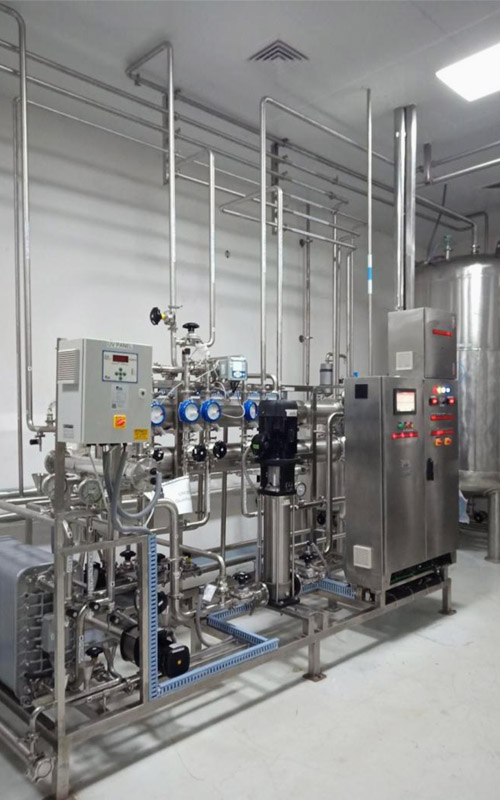
The unit is piped, wired and assembled on skid at the factory which reduces installation costs and start-up time.
≤0.4 Ra SS316L Electropolished permeate piping

Distribution pumps are provided with Variable Frequency Drive (VFD).

304 Stainless steel skid.
Premium quality valves and instruments.
Sophisticated safety interlocks and logics.

Heat sanitizable: arrangements available for microbial control.

21 CFR part 11 SCADA Systems available
Complete set of validation & supporting documentation.
Reliable Pre-treatment solutions as per feed water parameters.
PLC integration based controls.
| Purified Water Generation | |
|---|---|
| Parameters | Specification |
| Flow Rates | 250 LPH - 20,000 LPH |
| Feed Water Quality | Pre-treated water |
| Product Water Quality | USP / EP / IP Standards |
| Conductivity | ≤ 1.3 µS/cm @ 25°C |
| TOC | ≤ 500 ppb |
| Total Microbial Count | < 100 CFU/ml |
| Pathogens | Absent |
| RO Recovery | 65 – 80 % |
| Operating Pressure | 1 – 15 bar |
| Operating Temperature | 15 – 35°C |
| Sanitization Method | Hot Water (80-85°C) |
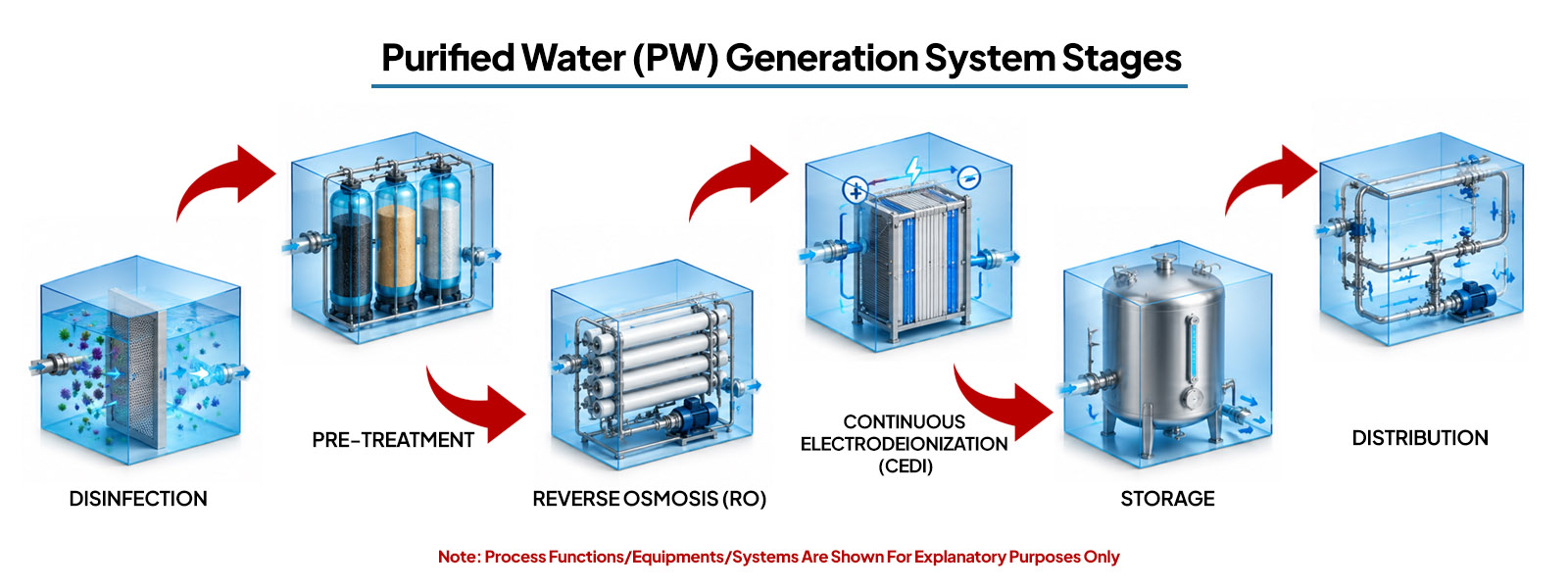
Neutralises harmful biological pathogens and microorganisms in the incoming raw water feed to prevent biofouling throughout the system.
Blocks and removes microscopic solids, reactive minerals, and chlorine to protect sensitive downstream membranes from physical damage and fouling.
Uses high pressure to push water through semi-permeable membranes that aid in stripping dissolved inorganic salts, organic molecules, and particulate matter.
Eliminates ionised impurities in water without the need for chemical regeneration using specialised resins and an electrical field.
Stores the purified water in sanitary, monitored vessels designed to maintain purity and prevent recontamination.
Continuously circulates purified water through a hygienically controlled closed-loop pipe network to supply to point-of-use.
Years Of Expertise in producing Purified water generation systems
PW Generation systems successfully commissioned globally
Positive passing rate of US FDA, WHO, and EU GMP ( Annex 1) compiance audits
Complete DQ/IQ/OQ validation package along with supporting documentation followed by protocol execution support.
Designed to meet current USP/BP/EU pharmacopoeia standards and WHO / cGMP requirements.




Find answers to common questions about our industrial and manufacturing services, processes, and support. If you need more details, our team is always ready to help.
Our experts are here to guide you through every step of your industrial transformation journey.
At the beginning of each shift an operator should check alarm history is check for any critical alarms generated in the previous shift. Operator should then ensure that all utilities (compressed air, raw power, UPS power, etc) are available as per specification and dosing chemical tanks are at sufficient levels. On starting the PW Generation system, the operator should verify that the system is operating within the acceptable flow, pressure, conductivity etc.
There are two ways a RO membrane generally undergoes fouling. One way of Fouling is where the RO membrane pore size has expanded due to oxidation, particulate damages to membrane body, etc resulting in the RO membrane to Pass. In this type of fouling the Operating pressure decreases and the output water quality deteriorates. This type of fouling is permanent and has no treatment and the only way to solve this problem is by replacing RO membranes . Another way of Fouling is where scale formation results in choking of RO membranes due to which there is a drop in product flow rates and increase in operating pressure. In this case operators can perform a chemical CIP including Caustic and acid cycled provided in the cleaning SOP provided by OEM. In both cases of Fouling, Operators can observe any deviation in operating pressure to predict the outcomes of either fouling and take corrective action as early as possible.
An EDI / CEDI unit (Continuous Electrodeionization) unit is a polishing unit to achieve less than 1µS/cm. To achieve this water quality there are recommended feed water quality defined by EDI manufacturer and also recommendations by system OEM. If there is any sudden increase in EDI product water quality operator should first check the feed water quality to EDI. If there is any increase in feed conductivity equivalent (should below max feed limits) to the EDI then the applied current & subsequent voltage can be increased appropriately to reduce the product water conductivity. .
There is no pharmacopoeia guideline mentioning the Hot water sanitization frequency for PW Generation skids. This Frequency and procedure should be documented and approved in coordination between OEM and QA team of the end Pharmaceutical company. In most cases a PW Generation system skid is heat sanitized once a month, Although it’s common to perform them every fortnight and once in three months too. After the heat sanitization cycle has been performed the most critical parameter is system temperature. Sufficient cooling cycle and cooling time should be considered to avoid any thermal shocks to the RO membrane and EDI.
The responsibility of reducing microbial load and eliminating pathogens from water lies on the pre-treatment system. Even so there have been instances of recurring microbial excursions in the PW generation system. In such instances it’s important to first check the pre-treatment output water quality. If Pre-treated water microbial quality is within limits then operator should perform a hot water sanitization to reduce any bioburden in the PW generation skid. Additionally for a recurring microbial excursions in the PW generation system an operator can also opt for chemical sterilization of the system using chemicals like MinCare (Hydrogen Peroxide + Peracetic acid). Its recommended to perform at-least three total three chemical cleaning cycles on three consecutive days to get the satisfactory results
The following preventive maintenance activities are essential to ensure long-term reliability: –
Share your equipment queries, raw water parameters or loop requirements. Our engineering team will review your requirements and get in touch within 48 hours to clarify your queries and provide you with our best purity solutions.