

WFI Generation (MCDP)

WFI Generation MCDP

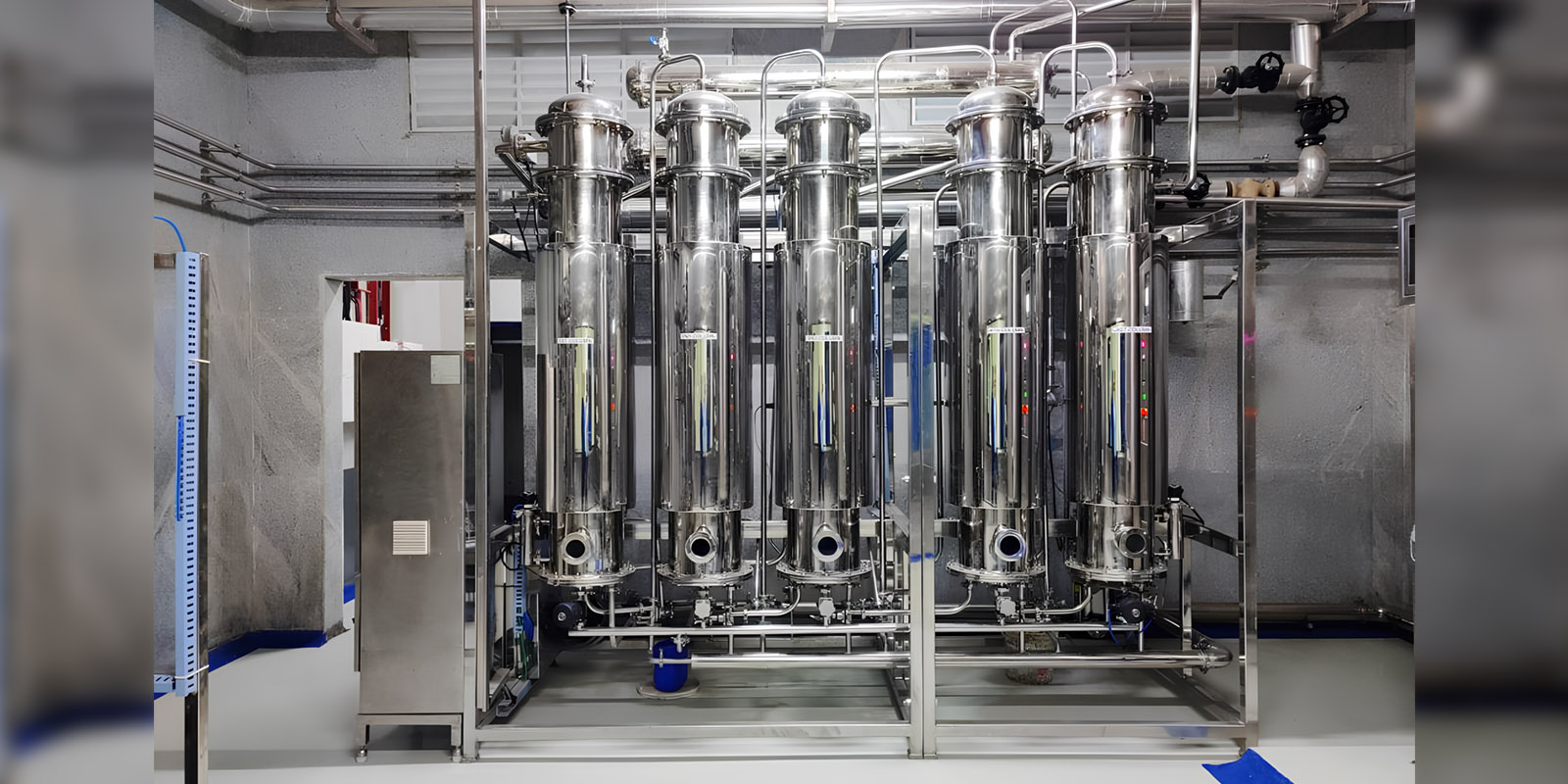
Flocon’s WFI Generation System using MCDP (Multi-Column/Effect Distillation Plant) converts suitably pretreated pharmaceutical water into Water for Injection (WFI) through a controlled process of evaporation, vapour separation and condensation. Designed with sanitary SS316L construction and optimised for hygienic operation, our WFI systems ensure reliable performance, superior product quality, and long-term operational efficiency. Leveraging advanced thermal technologies, hygienic engineering, and intelligent automation, Flocon delivers reliable and energy-efficient solutions that ensure uncompromised product quality, regulatory compliance, and operational excellence. Our system is designed in compliance with current pharmacopeial standards, including USP, EP, IP, and cGMP guidelines, ensuring the consistent production of high-purity Water for Injection and contamination-free water for critical manufacturing processes.Our WFI Generation Systems are designed to consistently produce pyrogen-free, microbiologically controlled Water for Injection for critical pharmaceutical and biotechnology applications.

Our systems deliver high-quality WFI suitable for: 

  • Intravenous (IV) Infusion 
  • Sterile Rinsing 
  • Drug Preparation 
  • Equipment Sanitization

Standard Features

Designed to comply with current USP, EP, BP/IP Pharmacopoeia requirements and cGMP guidelines.

Integrated NCGR (degassing) system for removal of dissolved gases for PSG.

Product contact parts in SS316L stainless steel with electropolished internal surfaces (Ra ≤ 0.4 µm typical).

Designed to meet requirements for dryness fraction, non-condensable gases and superheat testing

Efficient separation of endotoxins and pyrogens through multi-stage evaporation and separation for MCDP.

304 Stainless steel skid.

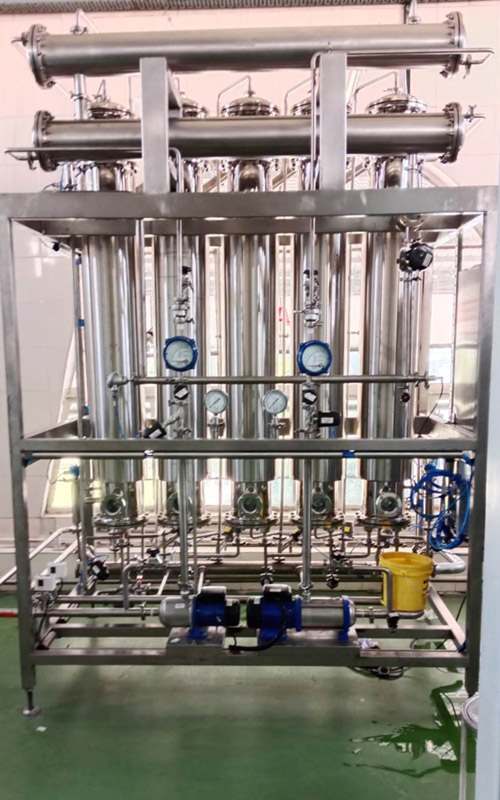
Multi-column falling-film distillation technology for production of pyrogen-free WFI.

Premium valves and instruments.

PLC-based controls with HMI/IPC operation.

All required safety interlocks.

21 CFR Part 11 optional.

Factory assembled, piped, wired and skid-mounted for easy installation on site.
System Parameters

WFI Generation
Parameters Range / Requirements
Capacities RO / RO-EDI Permeate
Conductivity < 1.3 µS/cm @ 25°C
Total Organic Carbon < 500 ppb
Total Microbial Count < 10 cfu/100ml
Endotoxin < 0.25 EU/ml
Op Temp 135 to 90°C
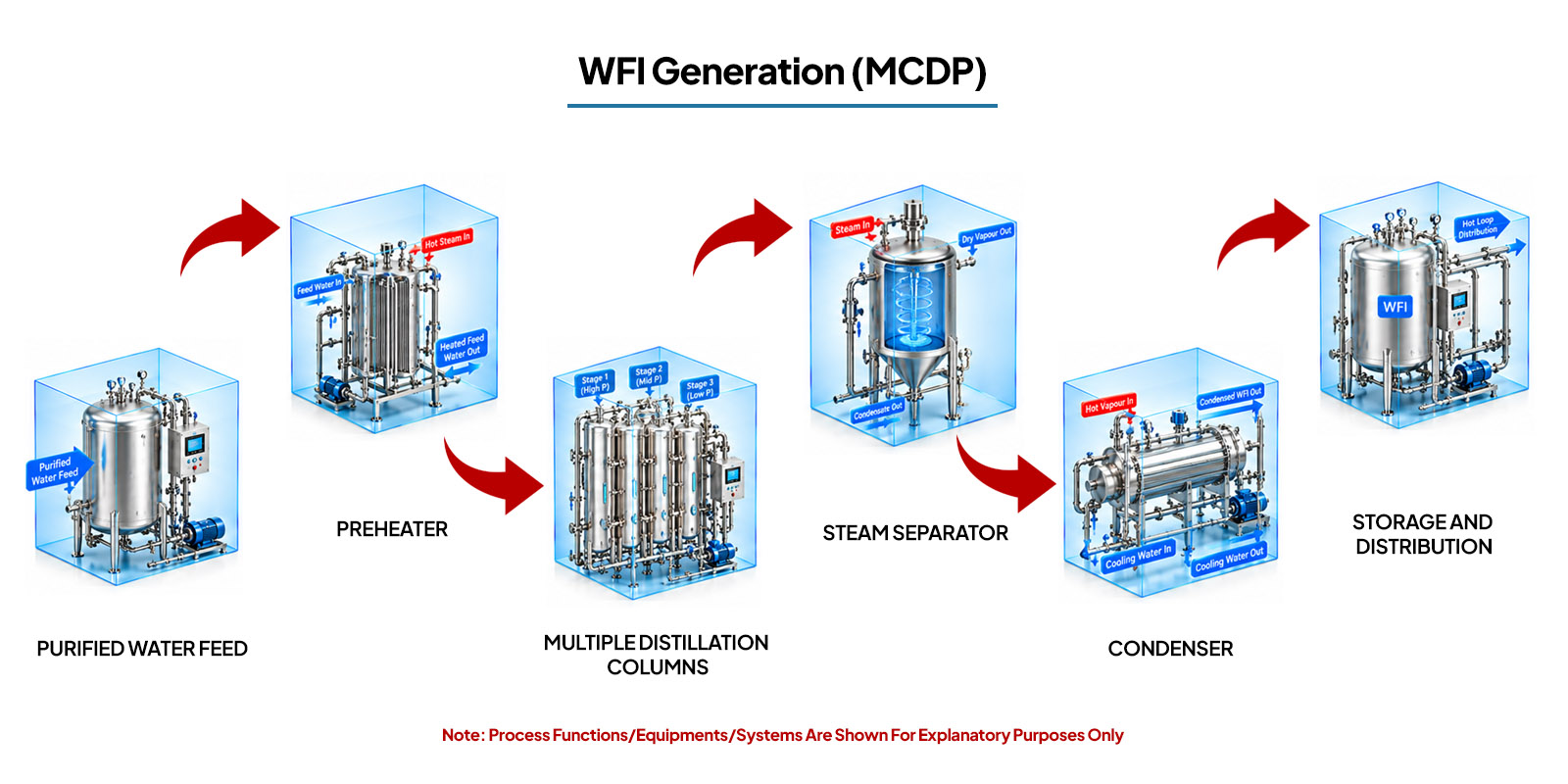
  1. 1

    Purified Water Feed

    Supplies suitably pretreated Purified Water to the WFI generation system as the starting feed to eliminate chemical and mineral contaminants before evaporation.

  2. 2

    Preheater

    Raises the feed-water temperature using available/recovered thermal energy to improve energy and distillation efficiency.

  3. 3

    Multiple Distillation Columns

    Uses sequential evaporation columns operating at decreasing pressures to repeat evaporation and condensation across multiple stages to progressively maximize purification and achieve efficient steam economy.

  4. 4

    Steam Separator

    Provides the final separation barrier using centrifugal action or demisters to separate pure vapour from condensed droplets, ensuring removal of endotoxins.

  5. 5

    Condenser

    Converts and condenses the purified steam/vapour back into high-purity, sterile, pyrogen-free Water for Injection (WFI).

  6. 6

    Storage and Distribution

    Hygienically stores generated WFI in self-sanitising tanks and circulates it continuously in a closed hot loop. This maintains purity and protects it from microbial contamination at any point of use.

Certifications & Compliance

Validation documentation

Complete DQ/IQ/OQ validation package along with supporting documentation followed by protocol execution support.

Pharmacopoeia standards

Designed to meet current USP/BP/EU pharmacopoeia standards and WHO / cGMP requirements.
Made To Serve

Pharmaceutical

Biotechnology

Food & Beverage

Diagnostics

Healthcard / Hospitals

Chemical Processing

Frequently Asked Questions

Find answers to common questions about our industrial and manufacturing services, processes, and support. If you need more details, our team is always ready to help.

Still Have Questions?

Our experts are here to guide you through every step of your industrial transformation journey.

Both can be acceptable for WFI, but the answer depends on which pharmacopoeia/regulatory jurisdiction you are operating under. The important regulatory change is that WFI is now generally defined by the required quality rather than exclusively by distillation in several major frameworks. The European Pharmacopoeia and US Pharmacopoeia revised its WFI monograph to permit a purification process equivalent to distillation; it specifically identifies RO (single- or double-pass) coupled with techniques such as EDI, ultrafiltration etc. 

In case of the multi-effect distillation system, the first effect receives external heating steam. The vapour produced there becomes the heating source for the second effect, whose vapour heats the third, and so on. Each successive effect operates at a lower pressure and therefore a lower boiling temperature. In case of the VC system, VC takes the vapour produced by the evaporator and compresses it.Compression increases its pressure and temperature, allowing that same vapour to condense on the heating side of the evaporator: So instead of needing several evaporation effects to cascade the heat, VC essentially uses a compressor to upgrade the vapour’s heat. 

For an injectable/parenteral facility, I would not size the WFI generator simply from total daily WFI consumption. Size it from the time-profile of demand, then check storage, distribution and redundancy. Do not unnecessary over design the WFI Generator capacity as it may lead to underside. For optimum sizing you should consider the average requirement per day and a sufficient storage capacity to take care of peak load requirement. 

For an injectable/parenteral facility, a WFI system is normally treated as a direct-impact, quality-critical utility. The regulatory expectation is not simply to qualify the still; the entire system from feed-water pretreatment through generation, storage, distribution and points of use must be demonstrated to consistently produce and maintain WFI quality. WHO specifically identifies WFI systems as systems that should undergo DQ/IQ/OQ/PQ or equivalent qualification. 

A WFI (Water for Injection) distillation unit mainly consumes thermal energy, with electricity for pumps, controls, and cooling.

  • Steam: Major utility; typically the largest energy demand for heating/evaporation.
  • Cooling water: Required to condense purified steam and remove heat.
  • Electricity: Pumps, feed-water systems, controls, and instrumentation.
  • Feed water: Usually pretreated/purified water.
  • Compressed air: May be required for pneumatic valves and controls.

Select WFI capacity based on the maximum simultaneous demand, not just average consumption:

  • Calculate WFI demand from formulation, equipment/line cleaning, CIP/SIP, rinsing, and other uses.
  • Establish peak hourly and daily demand and account for batch schedules.
  • Include storage-tank sizing to handle production peaks and downtime.
  • Provide a reasonable design margin (typically ~20–30%) for future expansion and demand variability.
  • Consider the generation technology, operating hours, recovery, redundancy, and maintenance requirements.
  • Validate the final capacity against GMP requirements and the facility’s water-system URS.

Clarify your queries with our High-Purity Specialist

Share your equipment queries, raw water parameters or loop requirements. Our engineering team will review your requirements and get in touch within 48 hours to clarify your queries and provide you with our best purity solutions.