
Clean-in-Place(CIP)/ Sterilize-in-Place(SIP) System

Clean-in-Place(CIP)/ Sterilize-in-Place(SIP) System

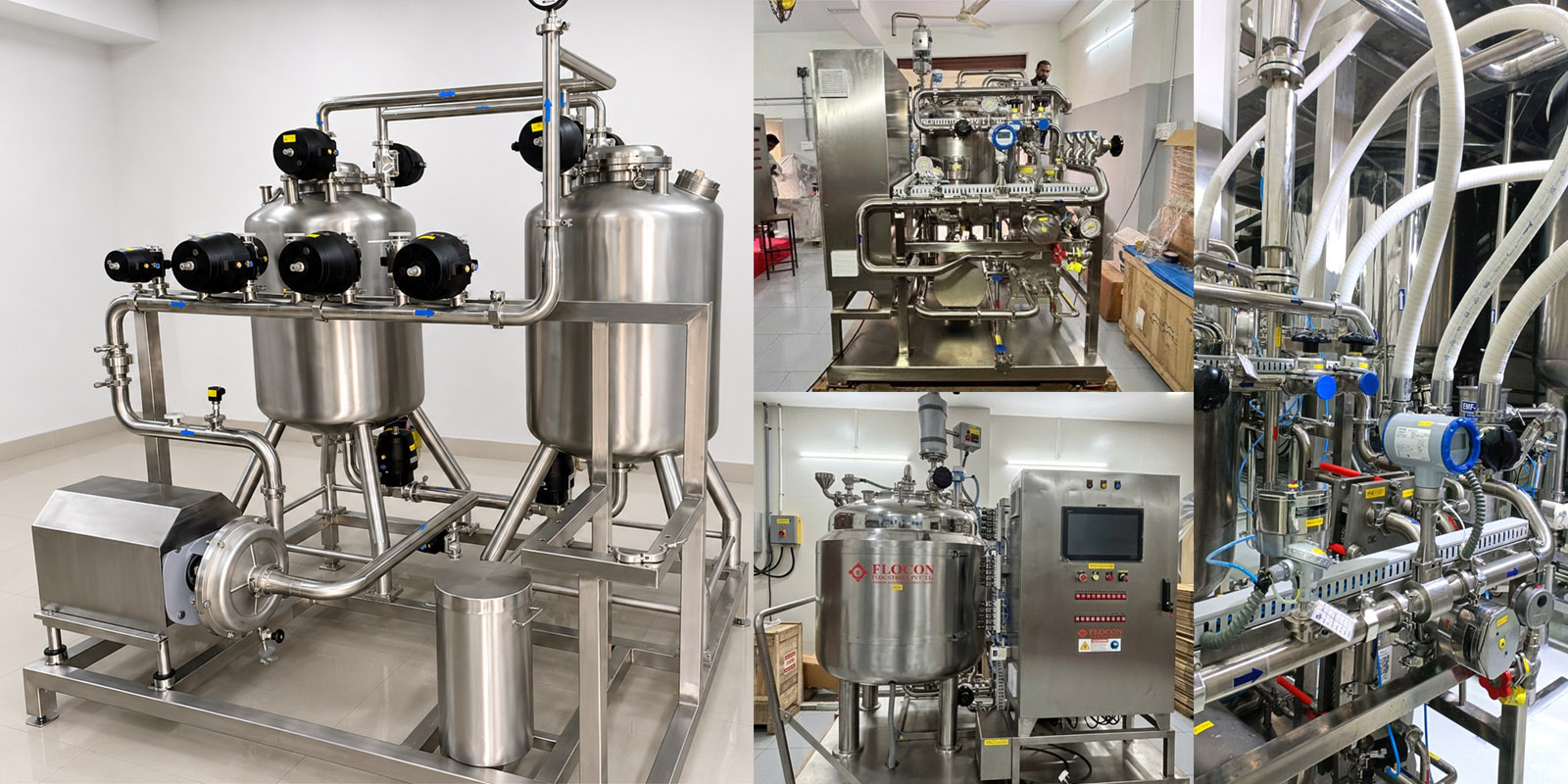
Flocon Industries’ Clean-in-Place(CIP)/ Sterilize-in-Place(SIP) System is a bespoke solution designed to sanitise equipment/systems efficiently to maintain process integrity. Our Clean-in-Place (CIP) function delivers automated, consistent, and effective surface cleaning of process vessels, pipelines, filters, and associated equipment, whereas the Sterilize-in-Place(SIP) function provides controlled thermal sterilisation using pure steam to eliminate microbial contamination and maintain aseptic conditions. By integrating advanced automation, recipe management, electronic batch records, and data integrity features, Flocon’s CIP & SIP solutions significantly reduce manual intervention, minimize downtime, improve operational efficiency, and ensure consistent cleaning and sterilization performance. Our systems are designed to maintain product quality, support regulatory compliance, and enable efficient manufacturing operations across critical process applications. Our custom solutions are designed in compliance with cGMP, FDA, and 21 CFR Part 11 requirements, ensuring reliable, repeatable, and fully validated cleaning and sterilization of process equipment without the need for dismantling.

Standard Features

Designed and manufactured in accordance with cGMP and ASME BPE hygienic design principles.

Chemical dosing system with controlled detergent concentration.
Fully automated operation with PLC-based control and HMI touchscreen interface.

Multi-tank configuration available for detergent, purified water, WFI, and recovery systems.

Recipe-driven cleaning and sterilization cycles with configurable process parameters.

Steam sterilization with automatic temperature control and validated holding periods.

Automatic control of temperature, flow rate, pressure, conductivity, and cycle time.

Integrated instrumentation including temperature transmitters, pressure gauges/transmitters, flow meters, conductivity sensors, and level sensors.

Integrated CIP and SIP functionality for cleaning and steam sterilization of process equipment and piping.

Data logging, batch reporting, alarm history, and audit trail capabilities (optional 21 CFR Part 11 compliance).

Constructed using SS 316L for all product-contact parts with hygienic surface finish.

Compact skid-mounted construction for ease of installation and maintenance.

Sanitary piping with orbital welding and hygienic fittings to eliminate dead legs.
Validation documentation support including DQ, IQ, OQ, FAT, SAT, and material certificates (as required).

Designed for compatibility with pharmaceutical process vessels, reactors, mixers, storage tanks, transfer lines, and filling systems.
System Parameters

For CIP Systems
Critical Parameters Range / Requirements
Water Quality RO / PW / WFI
Conductivity As Per Cleaning Requirement
Temperature Ambient to 90°C
Detergent Caustic or Specialized Detergents
pH 11 – 13 for Detergent Cleaning
Pressure 2 – 5 Bar
CIP Cycles As per Client Requirements
For SIP Systems
Critical Parameters Range / Requirements
Steam Quality Pure Steam
Conductivity < 1.3 µS/cm
Temperature 120°C – 130°C
Pressure 1 – 3 Bar
SIP Cycles As per Client Requirements
Steam Nature Dry and Pyrogen-free
Auto Temp Control Validated
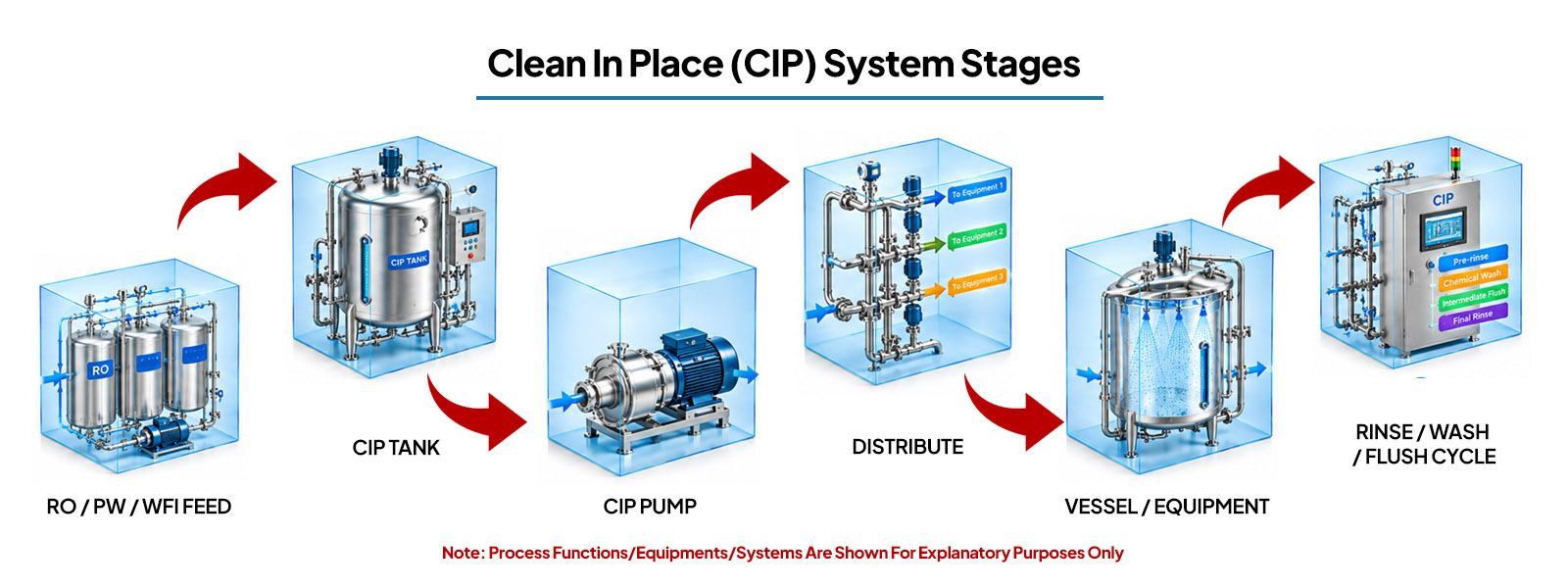
  1. 1

    RO / PW / WFI Feed

    Supplies purified process water (Reverse Osmosis, Purified Water, or Water for Injection) as the base for cleaning/rinsing of the target system/equipment.

  2. 2

    CIP Tank

    Stores measured quantities of wash water and chemical formulations at regulated temperatures for the cleaning process.

  3. 3

    CIP Pump

    Provides a consistent flow rate and hydraulic pressure to cleanse and scrub internal equipment/system surfaces effectively.

  4. 4

    Distribute

    Supplies cleaning formulations through sanitary piping and valves to sanitise specific equipment/systems.

  5. 5

    Vessel / Equipment

    It is the target unit where the cleaning formulation is sprayed with pressure to wash and sanitise the interior walls and internal contact surfaces.

  6. 6

    Rinse / Wash / Flush Cycle

    Executes automated cleaning sequence phases (pre-rinse, chemical wash, intermediate flush, and final high-purity rinse) to wash away any contaminant residue or cleaning formulation.

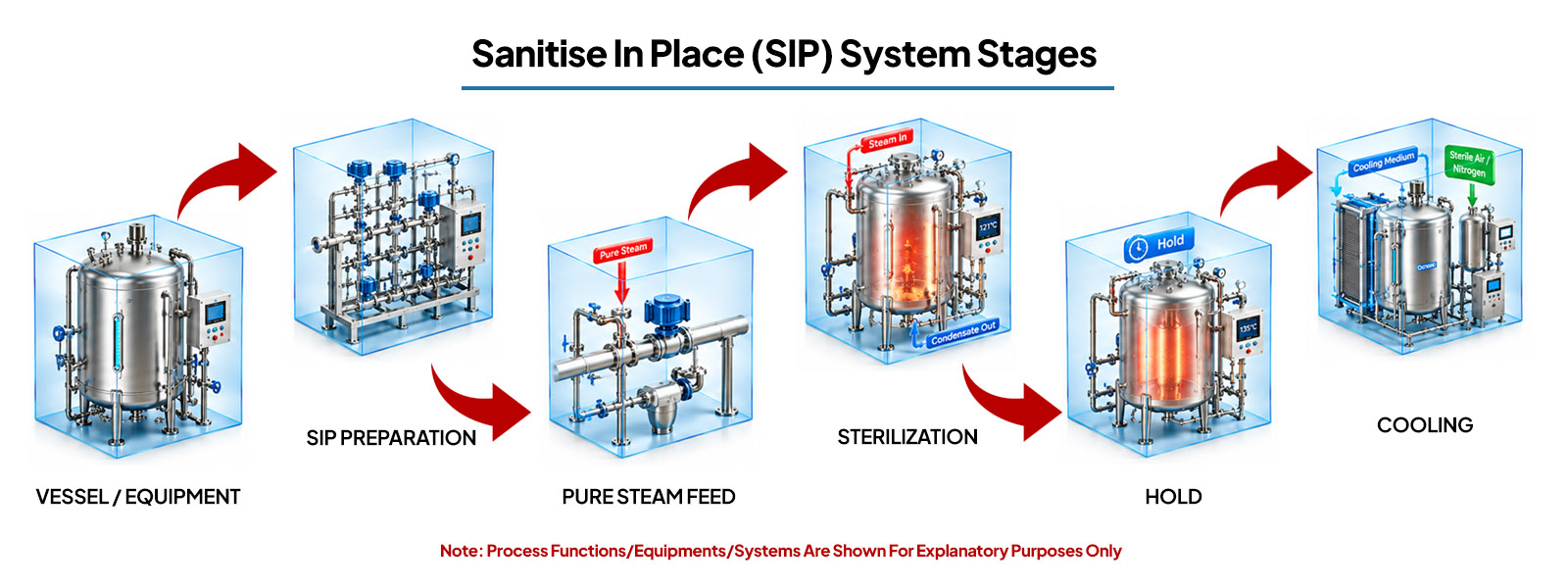
  1. 1

    Vessel / Equipment

    Denotes the pre-cleaned, airtight processing unit or system piping that requires thermal sanitisation from bio-contamination.

  2. 2

    SIP Preparation

    Configures valve settings, sets safety pressure seals and ensures ventilation of the system to exhaust air during thermal operations.

  3. 3

    Pure Steam Feed

    Blows dry, pyrogen-free saturated pure steam onto the target system's internal surfaces and piping to push out air and heat the equipment's internal surfaces.

  4. 4

    Sterilization

    Increases the system temperature to the set sanitising point (typically 120°C to 130°C), while also accounting for condensate drainage to eliminate cold spots.

  5. 5

    Hold

    Maintains the system-set sanitising temperature and saturated steam for a standard exposure time to ensure thorough microbial decontamination.

  6. 6

    Cooling

    Securely reduces input temperature and introduces sterile air or nitrogen pressure to prevent vacuum implosion during condensation while maintaining sterile conditions.

40+

Years of advisory, purification expertise and client trust for storage and distribution systems

100%

Positive passing rate of US FDA, WHO, and EU GMP ( Annex 1) compiance audits

Certifications & Compliance

Validation documentation

Complete DQ/IQ/OQ validation package along with supporting documentation followed by protocol execution support.
Pharmacopoeia standards

Designed to meet current USP/BP/EU pharmacopoeia standards and WHO / cGMP requirements.
Made To Serve

Pharmaceutical

Biotechnology

Food & Beverage

Diagnostics

Healthcard / Hospitals

Chemical Processing

Frequently Asked Questions

Find answers to common questions about our industrial and manufacturing services, processes, and support. If you need more details, our team is always ready to help.

Still Have Questions?

Our experts are here to guide you through every step of your industrial transformation journey.

CIP (Clean-in-Place) and SIP (Sterilize-in-Place) are complementary processes used in pharmaceutical manufacturing. CIP removes product residues, organic matter, and contaminants from equipment and piping without dismantling, typically using validated cycles of water, detergents, chemicals, temperature, and flow. SIP follows cleaning and uses saturated clean steam, typically around 121°C, to destroy viable microorganisms and achieve sterilization. CIP focuses on cleanliness, while SIP focuses on microbial sterility. CIP systems require control of flow, temperature, chemical concentration, and contact time; SIP requires validated temperature, pressure, steam quality, exposure time, and condensate removal. Both require documented validation and routine monitoring. 

Key CIP system components are based on the specific process and cleaning cycle requirement, but mainly include the following:

  • CIP tank: Holds and prepares cleaning solution.
  • CIP pump: Circulates cleaning fluid at the required flow and pressure.
  • Heat exchanger: Heats the cleaning solution to the required temperature.
  • Spray devices: Rotary spray heads or static spray balls distribute cleaning solution over equipment surfaces.
  • Instrumentation: Measures and controls temperature, flow, pressure, conductivity, pH, and chemical concentration.
  • Piping and valves: Provide hygienic circulation, drainage, and automated routing between the CIP skid and equipment.

A validated CIP/SIP system must demonstrate consistent cleaning and sterilization performance throughout its lifecycle:

  • FDA 21 CFR 211.67: Requires written, validated cleaning/sanitization/sterilization procedures, appropriate intervals, records, and equipment controls.
  • EU GMP: Requires qualification and validation of equipment, utilities, cleaning processes, and sterilization, supported by documented protocols, acceptance criteria, and change control.
  • WHO GMP: Requires documented qualification/validation and demonstrated reproducible performance, with appropriate monitoring and requalification. 

In practice, CIP/SIP validation confirms temperature, time, flow, pressure, chemical concentration, coverage, microbial control, and residue removal against predefined acceptance criteria.

  • Static spray balls: Simple, reliable, and economical; suitable for tanks with relatively easy-to-clean surfaces.
  • Rotary spray balls/nozzles: Rotate during CIP, providing better coverage and mechanical action; useful for larger or more challenging vessels.
  • Static jets: Fixed high-impact streams provide strong mechanical cleaning for specific areas or difficult residues.

Selection depends on

  • Equipment/vessel geometry and size
  • Soil type and cleaning difficulty
  • Required flow, pressure, and spray coverage
  • Drainability and hygienic design
  • Validation requirements, including documented coverage testing/riboflavin testing

The device should provide validated, repeatable coverage of all product-contact surfaces, including hard-to-reach areas.

CIP cleaning efficacy depends on four key parameters: Temperature, Action, Concentration, and Time. Higher temperature generally improves soil dissolution and chemical reaction, within material and product limits. Correct chemical concentration ensures effective removal of organic, inorganic, and microbial residues; excessive concentration may damage equipment. Adequate flow rate provides mechanical action, helping remove deposits from surfaces and piping. Sufficient contact time allows the cleaning chemistry to work effectively. These parameters are interdependent: if one is reduced, others may need adjustment. A validated CIP cycle establishes appropriate ranges and acceptance criteria to consistently achieve required cleaning performance. 

Cleaning validation is documented evidence that a cleaning process consistently removes product residues, cleaning agents, microorganisms, and other contaminants to predefined, scientifically justified acceptance limits.
For a GMP audit, demonstrate CIP effectiveness through:

  • Approved URS, risk assessment, protocols, and validation reports.
  • Qualified CIP equipment and calibrated instruments.
  • Validated CIP parameters: temperature, concentration, flow, pressure, and contact time.
  • Coverage testing (e.g., riboflavin) to verify spray-device coverage.
  • Swab and rinse sampling from worst-case locations, with validated analytical methods.
  • Defined residue, microbial, and endotoxin acceptance criteria.
  • Documented deviations, CAPAs, change control, and periodic review/revalidation.
  • Routine CIP cycle records demonstrating continued control.

Clarify your queries with our High-Purity Specialist

Share your equipment queries, raw water parameters or loop requirements. Our engineering team will review your requirements and get in touch within 48 hours to clarify your queries and provide you with our best purity solutions.